

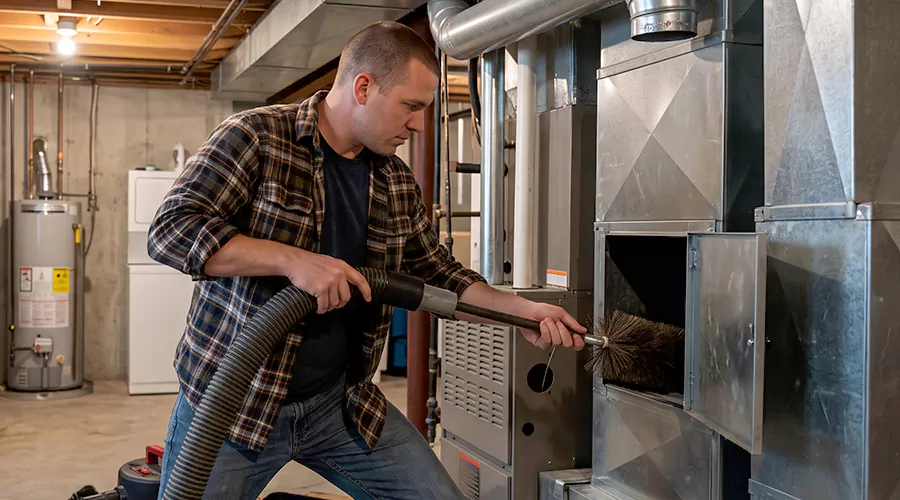
You can clean accessible furnace duct openings by turning off the heating system, removing dust from supply and return grilles, and vacuuming the nearby duct surfaces. Cleaning the concealed duct network requires professional source-removal equipment that loosens and collects accumulated debris. The appropriate method depends on the duct material and whether significant internal contamination is actually present.
Furnace ducts carry heated air throughout a home and return indoor air to the heating equipment. During normal operation, airborne particles can settle along duct surfaces and collect on return grilles. However, light dust deposits are common and do not automatically mean the system needs professional cleaning.
A furnace duct system may share its air distribution network with central air conditioning equipment. In this arrangement, the same supply and return passages operate during both heating and cooling. Cleaning the ductwork therefore affects a shared air distribution system rather than a separate heating-only network.
The main goal is to remove appropriate deposits without damaging the ducts or disturbing sensitive furnace components. A homeowner can handle ordinary vent-cover maintenance, but air duct deep cleaning of the internal supply and return network requires greater care. This distinction is particularly important around gas and oil-burning equipment.
What Are Furnace Ducts?
Furnace ducts are the passages that distribute heated air from a forced-air furnace to rooms throughout a building. Supply ducts carry warm air away from the equipment, while return ducts direct indoor air back toward the blower and heating system. A network of branches and larger trunks connects the furnace to the individual registers.
The duct system also includes plenums, which are chambers where air enters or leaves the equipment before moving through the network. Filters usually sit along the return air path so particles can be captured before reaching sensitive downstream components. The arrangement varies between furnace models and building layouts.
Furnace ducts are different from the combustion exhaust vent. The exhaust flue removes gases produced by burning fuel, while room-air ducts distribute air intended for occupied spaces. This difference affects both cleaning methods and safety requirements.
Supply Air Ducts
Supply ducts deliver heated air from the furnace toward rooms and hallways. Each branch connects to a supply register that releases air into the occupied space. Dust may collect inside these passages, particularly after construction or when debris enters through an unprotected opening.
A supply grille can often be cleaned with a vacuum and cloth. Internal branch cleaning is different because deposits may be located several feet beyond the opening. Specialized equipment is needed when substantial debris must be removed from the full passage.
Return Air Ducts
Return ducts collect room air and move it back toward the furnace. Return grilles can develop heavy-looking surface dust because particles carried by indoor air settle around their openings. This appearance does not necessarily mean the concealed returns are heavily contaminated.
The return path should also be inspected for air leaks and gaps around filters. Damaged connections can draw dust from unfinished spaces into the system. Correcting a leak may reduce recurring contamination more effectively than repeatedly cleaning the same deposits.
Furnace Plenums
Supply and return plenums connect the furnace equipment to the larger duct system. These areas may collect debris when filtration or duct connections are inadequate. Their cleaning requirements depend on the construction and condition of the system.
Plenums can also be close to electrical components or the heat exchanger. They should not be opened or modified casually. A qualified technician can identify suitable access points and avoid damaging the equipment during cleaning.
Do Furnace Ducts Really Need Cleaning?
Furnace ducts may need cleaning when significant contamination has been documented. However, routine cleaning is not automatically required because the home is several years old. The Environmental Protection Agency advises cleaning residential ducts as needed rather than following a fixed schedule.
The agency identifies several conditions that justify considering professional cleaning. These include substantial visible mold on suitable hard-surface HVAC components, vermin infestation, and ducts clogged with excessive dust or debris that may be released into occupied rooms. Each condition requires an appropriate response based on what is present.
A dusty register cover is not sufficient evidence that the full duct system needs cleaning. Ordinary household particles can collect on the grille without accumulating heavily inside the connected passage. Cleaning the accessible cover may be all that is necessary.
When contamination is associated with water damage or pests, the source should be corrected before ordinary cleaning begins. Otherwise, the same problem can return. The decision should be made from inspection findings rather than assumptions about the age of the furnace.
What Causes Furnace Ducts to Become Dirty?
Furnace ducts collect material from air moving through the heating system. Normal household dust is one source, but damaged return connections and renovation work can introduce additional debris. The type of contamination helps determine whether cleaning is appropriate.
Household Dust and Fibers
Ordinary household activities release fine particles into indoor air. Fabrics and carpeting can contribute loose fibers, while foot traffic moves settled dust back into circulation. Some particles eventually collect along duct surfaces.
A certain amount of deposited dust is expected in many forced-air systems. Much of it may remain attached to the duct walls rather than continuously circulate through rooms. The presence of light deposits alone does not establish a need for deep cleaning.
Dirty or Poorly Fitted Filters
The furnace filter captures particles along the return air path. A filter that is missing or poorly fitted may allow dust to enter the blower compartment and downstream components. A heavily loaded filter can also restrict airflow and create a separate performance problem.
Filters should match the furnace manufacturer's specifications. Choosing a filter with excessive airflow resistance may affect equipment operation. Proper fit and suitable replacement intervals help manage dust without creating unnecessary restrictions.
Leaking Return Duct Connections
A damaged return duct may draw air from an attic or crawlspace instead of only from the intended rooms. This can introduce dust and insulation particles that bypass the normal return grille. The amount entering the system depends on the size and location of the leak.
Cleaning may remove existing deposits, but it does not close the damaged connection. The air leak must be repaired using an appropriate method. Otherwise, the duct may continue drawing particles from the same source.
Renovation Debris
Drywall sanding and other construction activities can release large amounts of fine dust. If duct openings are left unprotected during this work, debris may enter supply or return passages. Operation of the heating system can also move particles through the network.
The actual need for cleaning depends on whether material entered the ducts. A home that kept openings protected may not require professional cleaning after renovation. Visible internal construction debris provides a stronger reason for inspection.
Pest Activity
Rodents or insects can sometimes enter ducts through damaged openings. Nesting debris and contaminated material may remain after the animals are removed. This condition requires a different response from ordinary dry dust.
Do not disturb suspected pest droppings with an ordinary household vacuum. Appropriate pest remediation and controlled cleanup may be necessary. Entry points should be repaired to prevent renewed contamination.
What Are the Signs That Furnace Ducts May Need Cleaning?
Dust on a return grille is common and can be removed during ordinary housekeeping. More significant warning signs involve substantial internal debris or evidence that material is being released into rooms. Moisture and pest-related conditions also deserve attention because cleaning alone may not correct them.
Look for these conditions:
- Large amounts of visible debris collect inside accessible duct passages.
- Dust or particles are actually discharged through supply registers.
- Construction materials have entered unprotected furnace ducts.
- Pest nesting material is visible in the air distribution system.
- An infestation has affected ductwork or nearby equipment.
- Significant suspected mold is visible on appropriate internal surfaces.
- Water damage has affected duct insulation.
- The filter housing contains major gaps that allow particle bypass.
- Unusual contamination is documented during furnace servicing.
- Ductwork remains dirty because an underlying leak or moisture problem has not been corrected.
These signs should be interpreted in context. Weak airflow or uneven heating may result from a dirty filter or damaged duct rather than internal dust. A cleaning service should not be recommended solely because one room is cold.
A musty odor can originate from materials outside the duct system. If moisture damage is suspected, investigate its source before attempting cleaning. The condition of the surrounding building materials may be more important than the amount of visible duct dust.
What Tools Can You Use to Clean Furnace Vents?
Homeowners can clean accessible vent covers using basic household equipment. Soft tools reduce the chance of damaging painted grilles or adjustable louvers. Cleaning should remain limited to areas that can be reached without opening furnace compartments or disturbing concealed duct insulation.
| Tool | Suitable Household Task |
|---|---|
| Vacuum with brush attachment | Remove dust from grille surfaces |
| Microfiber cloth | Wipe accessible covers |
| Soft-bristled brush | Clean narrow vent openings |
| Mild detergent | Wash compatible removable grilles |
| Flashlight | Examine nearby accessible surfaces |
| Screwdriver | Remove ordinary grille fasteners |
| Stable step stool | Reach elevated wall or ceiling vents |
| Replacement furnace filter | Restore filtration when required |
A household vacuum does not provide the controlled collection used for professional internal duct cleaning. Inserting a rigid vacuum hose too far into a flexible duct can damage its liner. More aggressive cleaning should not be attempted without identifying the materials involved.
Do not use household disinfectant sprays or pour water into furnace ducts. Moisture can damage insulation or enter components that should remain dry. If substantial contamination is present, professional inspection is more appropriate.
How to Clean Accessible Furnace Duct Openings Step by Step?
Cleaning the visible furnace vents is a useful household maintenance task. It removes deposits from grilles and the nearby openings without disturbing the concealed duct system. The steps below are appropriate for ordinary dry dust on accessible supply and return covers.
Step 1. Turn Off the Furnace
Switch off heating operation at the thermostat and wait for the blower to stop. This prevents air from moving through the opening while dust is being removed. If the furnace has recently operated, allow accessible components to cool before working nearby.
Do not open combustion compartments or remove panels that protect electrical equipment. The purpose is to clean ordinary air registers, not service the furnace mechanism. Any work requiring equipment disassembly should follow the manufacturer's instructions and appropriate qualifications.
Step 2. Locate Supply and Return Openings
Walk through the home and identify the visible heating registers. Supply vents release air into the rooms, while return grilles direct indoor air back toward the furnace. The two types may differ in size and placement.
Note which covers contain significant surface deposits. It is not necessary to remove every grille when only a few require ordinary cleaning. Record unusual staining or damaged connections before disturbing the area.
Step 3. Vacuum the Grille Surface
Use a soft brush attachment to collect dust from the visible louvers and surrounding edges. Work gently so the metal or plastic cover is not scratched. Thick deposits are easier to remove when vacuumed before damp wiping.
Return grilles may require additional attention because air moves toward them during operation. Cleaning their visible surfaces can be part of normal housekeeping. The dust on the grille does not automatically indicate contamination farther inside.
Step 4. Remove the Cover if Appropriate
An ordinary grille may be held in place by screws or designed to lift out of its opening. Remove it only when it can be detached safely without disturbing nearby materials. Keep the fasteners together for reinstallation.
Ceiling covers should be supported during removal so they do not fall. A stable step stool or ladder may be needed. If the cover cannot be removed easily, clean the accessible surface without forcing it apart.
Step 5. Inspect the Nearby Duct Opening
Use a flashlight to examine the area immediately beyond the grille. Look for loose household debris or unusual deposits near the entrance. Avoid scraping internal duct liners or reaching into areas that cannot be seen.
If material appears wet or contaminated by pests, stop before disturbing it. Substantial suspected mold also requires appropriate assessment. Ordinary household cleaning tools are not suitable for every type of contamination.
Step 6. Vacuum Accessible Loose Debris
Carefully remove loose dry material from the visible entrance using a suitable vacuum attachment. Keep the attachment within the safely accessible area and avoid pushing it into concealed bends. The objective is to remove nearby deposits without damaging the duct.
A small amount of ordinary dust does not justify aggressive cleaning. If significant debris continues beyond the accessible area, document the condition for professional assessment. Deeper cleaning may require controlled vacuum collection and suitable duct access.
Step 7. Wash Compatible Register Covers
Wash removable covers with mild detergent and warm water when their material and finish permit. Use a soft cloth or brush to remove dust trapped between the louvers. Avoid abrasive cleaners that could damage paint or protective coatings.
Do not soak electronic registers or components containing moisture-sensitive material. Follow the manufacturer's instructions for unusual vent covers. Allow washable parts to dry completely before reinstalling them.
Step 8. Reinstall the Covers
Return each grille to its original opening and secure it properly. Check that adjustable louvers remain functional and have not been accidentally closed. A damaged or loose cover can rattle when the furnace blower operates.
Do not block return grilles with furniture or decorative coverings. The furnace relies on a suitable return air path. Restricting it may affect airflow and heating performance.
Step 9. Check the Furnace Filter
Inspect the furnace filter according to the equipment manufacturer's directions. Replace it when necessary with a suitable type and size. A poorly fitted or excessively restrictive filter can create airflow problems even when the ducts are clean.
The filter should be installed in the correct orientation and fit its housing without substantial bypass gaps. Do not operate the furnace without its required filter as a routine cleaning method. Proper filtration reduces unwanted dust reaching downstream components.
Step 10. Restore Normal Heating
After cleaning and reinstalling the grilles, restore normal furnace operation. Check that airflow through the cleaned openings is similar to the condition observed before the work. Listen for rattling that might indicate a cover was not secured properly.
If one room continues receiving weak airflow, the cause may involve a duct restriction or equipment issue. Additional vacuuming of the grille is unlikely to correct an unrelated problem. Professional diagnosis may be necessary when symptoms persist.
How Do Professionals Clean Furnace Supply and Return Ducts?
Professional furnace duct cleaning addresses internal passages that cannot be reached effectively with household tools. The process generally uses controlled source removal, which combines debris agitation and vacuum collection. The equipment and procedure must be suitable for the duct materials.
The contractor begins by inspecting the network and determining whether significant contamination is present. The supply and return paths are identified so the work can be organized. Damaged duct sections or suspected hazardous materials may require a different response before cleaning begins.
Appropriate access is established to the affected ducts. A vacuum collection system is connected to capture loosened material, and suitable brushing or air tools remove deposits from accessible internal surfaces. Different techniques may be needed for rigid sheet metal and flexible or internally insulated ducts.
The cleaning plan should also consider relevant plenums and furnace-associated air-handling components when contamination affects them. Qualified HVAC service personnel should handle components that require specialized disassembly. Afterward, access openings are restored and the system is checked for normal operation.
A professional should be able to document the condition before and after cleaning. If a duct contains physical damage, the defect should be reported rather than concealed. A clean duct with an unsealed opening may still perform poorly.
Can You Clean Furnace Ducts With a Shop Vacuum?
A shop vacuum can remove ordinary loose dust from a nearby accessible opening when used appropriately. However, it cannot reliably clean the entire supply and return duct network. Its reach is limited, and aggressive brushing without controlled collection may release deposits into the home.
A household vacuum hose can also damage flexible duct liners if it is forced through bends. The risk is greater when the duct contains fiberglass insulation or another delicate internal surface. Tools should remain within areas that can be safely viewed and reached.
Professional cleaning systems are designed to loosen and collect material throughout suitable parts of the duct network. The approach involves more than simply applying suction at one register. When significant internal contamination exists, professional assessment is preferable to improvised deep cleaning.
Can You Clean Furnace Ducts With a Leaf Blower or Compressed Air?
An ordinary leaf blower or general-purpose air compressor should not be used to force dust through an unknown furnace duct system. Excessive airflow can dislodge material without collecting it and may spread particles into occupied rooms. Weak connections can also release debris into concealed cavities.
Professional cleaners sometimes use air agitation equipment, but this works with a controlled collection system. The equipment is selected for the duct material and layout. It is not equivalent to blowing uncontrolled air into one end of the network.
A furnace duct contains multiple branches that may distribute loosened material in different directions. This makes an improvised blow-out particularly unsuitable. Physical collection is necessary when the goal is to remove contamination from the building.
How Do You Clean Flexible Furnace Ducts?
Flexible furnace ducts contain a thin inner liner that carries air, with insulation and an outer jacket surrounding it. Their construction requires greater care than sound rigid sheet metal. Aggressive rotating brushes can tear the liner and create new air leaks.
A qualified cleaner should identify the flexible duct material and evaluate its condition before selecting tools. Gentle methods may be appropriate for suitable intact ducts. Severely damaged or contaminated flexible sections may be more practical to replace.
The outer insulation jacket should not be cut open casually for cleaning access. Damaging the protective covering can expose insulation to moisture. A repair may then become necessary even though the original problem involved only ordinary dust.
When a flexible duct is wet or contains substantial contaminated insulation, cleaning may not restore it adequately. The affected material should be evaluated for replacement after the moisture source is corrected.
What Is the Difference Between Cleaning Furnace Ducts and Cleaning the Furnace?
Furnace duct cleaning focuses on the passages that distribute heated air. Furnace cleaning or servicing involves mechanical and heating components inside the equipment cabinet. These tasks may be scheduled together, but they require different methods and levels of qualification.
| Component | Furnace Duct Cleaning | Furnace Maintenance or Service |
|---|---|---|
| Supply ducts | Removes appropriate deposits | Inspects airflow when needed |
| Return ducts | Removes appropriate deposits | Checks return restrictions |
| Registers | Cleans accessible covers | May inspect airflow distribution |
| Filter | Checks or replaces as required | Checks proper fit and suitability |
| Blower assembly | Cleaning when included and appropriate | Inspects motor and operation |
| Burners | Not ordinary duct cleaning | Qualified inspection and servicing |
| Heat exchanger | Not a household duct-cleaning task | Qualified inspection for condition and safety |
| Combustion flue | Not a room-air duct | Qualified venting inspection |
The heat exchanger separates combustion gases from the indoor air being circulated. Its condition is a furnace safety matter. Cleaning an air register or supply branch does not establish whether the heat exchanger is operating safely.
The combustion flue is also separate from the room-air ducts. It removes exhaust gases from fuel-burning equipment. A damaged flue should never be cleaned or patched using ordinary HVAC duct methods.
Is Furnace Duct Cleaning Safe Around Gas Furnaces?
Cleaning supply and return ducts can be performed safely when appropriate procedures protect the furnace and its combustion components. However, gas furnaces require additional caution because their operation involves fuel and combustion exhaust. A duct cleaning contractor should not disturb these systems without appropriate qualifications.
A furnace flue may contain hot surfaces or exhaust gases during operation. Never insert a household cleaning brush into the flue while assuming it is an ordinary return duct. The two components must be identified before work begins.
The EPA recommends having fuel-burning furnaces and similar appliances inspected and serviced before each heating season to reduce carbon monoxide risks. This safety maintenance is separate from deciding whether the air ducts need cleaning.
If a carbon monoxide alarm sounds, leave the building and follow the alarm manufacturer's emergency instructions. Do not try to locate the source by opening furnace panels. Contact emergency services from outside the building.
What Should You Do if Furnace Ducts Contain Mold?
Significant suspected mold inside furnace ductwork requires evaluation before ordinary cleaning. Mold may develop when water enters the system or moisture remains on suitable internal surfaces. However, black or gray dust alone does not prove that mold is present.
The EPA advises correcting the moisture source when mold contamination is found. Sound hard surfaces may be cleanable using suitable methods, but wet or moldy fiberglass insulation generally needs replacement. Cleaning the surface without addressing moisture can allow the problem to recur.
Do not spray bleach or household disinfectants deep into furnace ducts. Such products may be unsuitable for internal HVAC materials and cannot restore damaged insulation. The appropriate response depends on the material and the extent of contamination.
When known or suspected contamination could be distributed by the HVAC blower, seek professional guidance before continuing operation. A qualified assessment helps determine what should be cleaned or replaced.
How Often Should Furnace Ducts Be Cleaned?
There is no universal interval requiring residential furnace ducts to be cleaned every year or every few years. The EPA recommends cleaning only when specific conditions justify it. A home with well-maintained filtration and dry, sound ductwork may not require routine professional cleaning.
Furnace maintenance should follow a separate schedule. Fuel-burning heating equipment should receive appropriate pre-season service, and filters should be checked according to the manufacturer's recommendations. These tasks support normal heating operation whether or not duct cleaning is needed.
Visible grille dust can be cleaned during ordinary housekeeping. Significant construction debris or pest contamination may justify internal cleaning sooner. The decision should follow the actual findings rather than a calendar alone.
What Mistakes Should You Avoid When Cleaning Furnace Ducts?
Improper cleaning can damage ducts or disturb sensitive furnace components. The most serious errors involve confusing combustion equipment with ordinary air distribution ducts. Household cleaning should remain limited to safe and accessible surfaces.
Avoid these mistakes:
- Removing combustion or electrical access panels without proper qualifications.
- Inserting tools into the furnace exhaust flue.
- Using a stiff rotating brush inside delicate flexible ducts.
- Forcing vacuum hoses into concealed bends.
- Spraying water or bleach into air distribution passages.
- Running the blower while substantial deposits are being disturbed.
- Ignoring suspected asbestos-containing insulation.
- Vacuuming suspected pest contamination with ordinary household equipment.
- Cleaning wet insulation instead of assessing replacement.
- Leaving vent covers or cleaning access openings unsecured.
- Blocking return openings after cleaning.
- Assuming duct cleaning will repair an overheating furnace.
Repeated high-temperature shutdowns or weak heating require proper diagnosis. A blocked filter or duct restriction may contribute, but other furnace components may also be involved. Cleaning alone should not be presented as a repair for an unidentified mechanical problem.
How Can You Keep Furnace Ducts Cleaner?
Keeping furnace ducts reasonably clean involves filtration and preventing unwanted debris from entering the network. A well-fitting filter helps capture particles carried by return air. The correct filter type and replacement schedule should follow the equipment manufacturer's recommendations.
Vacuum visible supply and return grilles during household cleaning. Check that furniture does not obstruct major return openings. Keeping these openings clear supports normal airflow and makes unusual deposits easier to identify.
Repair damaged return duct connections because they may draw dust from attics or crawlspaces. During renovations, protect duct openings from construction debris and avoid operating the system during particularly dusty work when practical. These precautions help reduce contamination before it reaches concealed passages.
When Should You Hire a Professional?
Professional cleaning is appropriate when substantial internal deposits or documented contamination cannot be addressed through safe household maintenance. A qualified provider can inspect the supply and return network and use equipment matched to the duct materials. Controlled collection helps prevent debris from being released into occupied rooms.
A professional assessment is also necessary when moisture damage or pests are involved. Cleaning may need to follow remediation or repair of the original problem. The contractor should explain which components need attention and how the finished work will be checked.
For gas or oil-burning furnaces, qualified HVAC service remains important. A technician should evaluate combustion equipment and safety controls according to the manufacturer's instructions. Ordinary duct cleaning does not replace a furnace safety inspection.
Conclusion
Cleaning furnace ducts begins with maintaining accessible registers and checking the condition of the air distribution system. Homeowners can remove ordinary surface dust, while significant deposits inside concealed ducts generally require professional source removal. Different duct materials need different cleaning methods, and fuel-burning furnace components require separate safety precautions. Routine duct cleaning is not automatically necessary on a fixed schedule. Start by inspecting the filter and visible supply and return openings before deciding whether deeper cleaning is warranted.